This page was generated from a Jupyter notebook. You can download it here.
Three-dimensional Disk Distribution Functions
The quasiisothermaldf class implements the quasi-isothermal distribution function for three-dimensional disk populations from Binney 2010 (with modifications by Binney & McMillan 2012). Research shows that this distribution function provides a good model for the DF of mono-abundance sub-populations (MAPs) of the Milky Way disk (see Ting et al.
2013 and Bovy et al. 2013). Unlike the 2D DFs, it is expressed in terms of action-angle variables \((J_R, L_z, J_z)\) and requires an action-angle calculator.
[1]:
%matplotlib inline
import numpy
import matplotlib.pyplot as plt
import warnings

warnings.filterwarnings("ignore", category=RuntimeWarning)
warnings.filterwarnings("ignore", category=UserWarning)
Setup: potential and action-angle calculator
We use MWPotential2014 as the gravitational potential and set up an actionAngleAdiabatic instance to compute actions (note that generally actionAngleStaeckel is more accurate, but we use actionAngleAdiabatic for this demonstration and discuss the Staeckel backend later):
[2]:
from galpy.potential import MWPotential2014
from galpy.actionAngle import actionAngleAdiabatic

aA = actionAngleAdiabatic(pot=MWPotential2014, c=True)
Initializing the quasi-isothermal DF
The quasiisothermaldf takes radial scale lengths and velocity dispersions as parameters:
hr: radial scale length of the surface densitysr: radial velocity dispersion at the solar radiussz: vertical velocity dispersion at the solar radiushsr: scale length of the radial velocity dispersionhsz: scale length of the vertical velocity dispersion
[3]:
from galpy.df import quasiisothermaldf

qdf = quasiisothermaldf(
    hr=1.0 / 3.0,  # radial scale length
    sr=0.2,  # sigma_R at R_0
    sz=0.1,  # sigma_z at R_0
    hsr=1.0,  # sigma_R scale length
    hsz=1.0,  # sigma_z scale length
    pot=MWPotential2014,
    aA=aA,
)
Evaluating the DF at a point
The DF can be evaluated at a given \((R, v_R, v_T, z, v_z)\) point. Internally it computes the actions and evaluates \(f(J_R, L_z, J_z)\):
[4]:
# DF value at the solar circle moving on a circular orbit
print("f(R=1, vR=0, vT=1, z=0, vz=0) =", qdf(1.0, 0.0, 1.0, 0.0, 0.0))
f(R=1, vR=0, vT=1, z=0, vz=0) = [514.84583859]
DF moments
The quasiisothermaldf can compute various moments by marginalizing over velocity. These integrals use Gauss-Legendre quadrature by default.
[5]:
# Vertically-integrated surface density at R=1
print("Surface mass at R=1:", qdf.surfacemass_z(1.0))

# Velocity dispersions at (R=1, z=0)
print("sigma_R^2 at (R=1, z=0):", qdf.sigmaR2(1.0, 0.0))
print("sigma_T^2 at (R=1, z=0):", qdf.sigmaT2(1.0, 0.0))
print("sigma_z^2 at (R=1, z=0):", qdf.sigmaR2(1.0, 0.0))
Surface mass at R=1: 0.5684828858456422
sigma_R^2 at (R=1, z=0): 0.04329359333259306
sigma_T^2 at (R=1, z=0): 0.023214249869379366
sigma_z^2 at (R=1, z=0): 0.04329359333259306
We can also compute the mean actions as a function of position:
[6]:
numpy.random.seed(1)
print("<J_R> at (R=1, z=0):", qdf.meanjr(1.0, 0.0, mc=True, nmc=10000))
print("<L_z> at (R=1, z=0):", qdf.meanlz(1.0, 0.0, mc=True, nmc=10000))
print("<J_z> at (R=1, z=0):", qdf.meanjz(1.0, 0.0, mc=True, nmc=10000))
<J_R> at (R=1, z=0): 0.03406689383453625
<L_z> at (R=1, z=0): 0.9140887169726567
<J_z> at (R=1, z=0): 0.0017174864094052277
Surface density profile
Let’s compute and plot the surface density as a function of radius:
[7]:
Rs = numpy.linspace(0.3, 2.0, 21)
smass = numpy.array([qdf.surfacemass_z(R) for R in Rs])
plt.semilogy(Rs, smass)
plt.xlabel(r"$R$")
plt.ylabel(r"$\Sigma(R)$")
plt.title("Quasi-isothermal DF surface density profile");
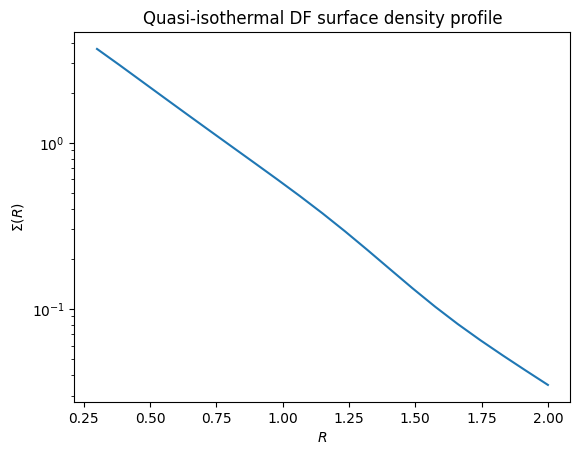
We can estimate the actual scale length from the DF by taking the log-slope:
[8]:
# Estimate scale length from the DF near R=1
dR = 0.01
sm1 = qdf.surfacemass_z(1.0 - dR)
sm2 = qdf.surfacemass_z(1.0 + dR)
hR_est = -2.0 * dR / numpy.log(sm2 / sm1)
print(f"Estimated scale length: {hR_est:.3f} (input: {1.0 / 3.0:.3f})")
Estimated scale length: 0.372 (input: 0.333)
The actual scale length of the DF is close to, but not exactly equal to, the input hr because the quasi-isothermal DF is only approximate.
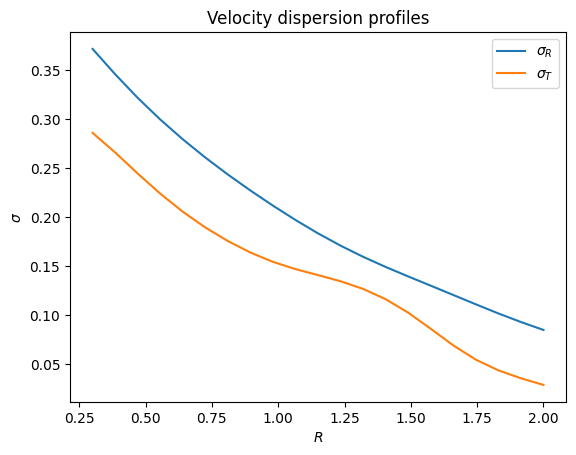
Velocity dispersion profiles
We can also compute the velocity dispersion profiles as a function of radius:
[9]:
sigR2 = numpy.array([qdf.sigmaR2(R, 0.0) for R in Rs])
sigT2 = numpy.array([qdf.sigmaT2(R, 0.0) for R in Rs])
plt.plot(Rs, numpy.sqrt(sigR2), label=r"$\sigma_R$")
plt.plot(Rs, numpy.sqrt(sigT2), label=r"$\sigma_T$")
plt.xlabel(r"$R$")
plt.ylabel(r"$\sigma$")
plt.legend()
plt.title("Velocity dispersion profiles");
Estimating scale lengths
We can estimate the actual scale lengths of the DF (which differ slightly from the input parameters):
[10]:
print("Estimated radial scale length hr:", qdf.estimate_hr(1.0), "(input: 0.333)")
print("Estimated sigma_R scale length hsr:", qdf.estimate_hsr(1.0), "(input: 1.0)")
print("Estimated sigma_z scale length hsz:", qdf.estimate_hsz(1.0), "(input: 1.0)")
Estimated radial scale length hr: 0.32908013715579104 (input: 0.333)
Estimated sigma_R scale length hsr: 1.1913934874850225 (input: 1.0)
Estimated sigma_z scale length hsz: 1.0506910721558342 (input: 1.0)
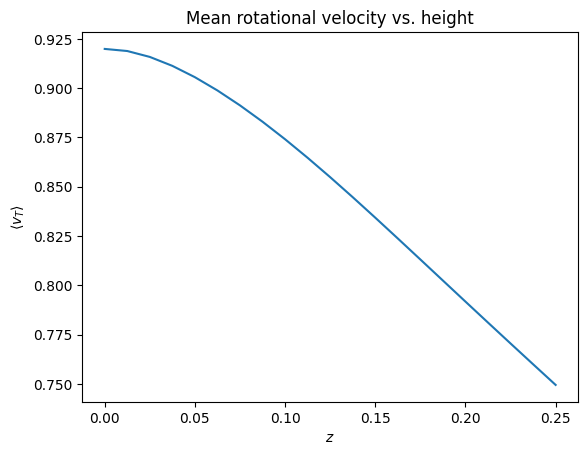
Mean velocities
Mean velocities can also be computed as a function of radius:
[11]:
# Mean radial velocity is zero for an axisymmetric potential
print("meanvR(1, 0):", qdf.meanvR(1.0, 0.0))
# Mean vertical velocity is also zero
print("meanvz(1, 0):", qdf.meanvz(1.0, 0.0))
# Mean tangential velocity shows asymmetric drift
print("meanvT(1, 0):", qdf.meanvT(1.0, 0.0))

# meanvT decreases with height above the plane
zs = numpy.linspace(0.0, 0.25, 21)
mvts = numpy.array([qdf.meanvT(1.0, z) for z in zs])
plt.plot(zs, mvts)
plt.xlabel(r"$z$")
plt.ylabel(r"$\langle v_T \rangle$")
plt.title("Mean rotational velocity vs. height");
meanvR(1, 0): 0.0
meanvz(1, 0): 0.0
meanvT(1, 0): 0.9198834638078105
Velocity ellipsoid tilt
The tilt of the velocity ellipsoid is zero when using the adiabatic approximation (because it assumes decoupled planar and vertical motions). The Staeckel approximation captures the coupling better:
[12]:
from galpy.actionAngle import actionAngleStaeckel

# Staeckel-based action-angle calculator
aAS = actionAngleStaeckel(pot=MWPotential2014, delta=0.45, c=True)
qdfS = quasiisothermaldf(
    1.0 / 3.0,
    0.2,
    0.1,
    1.0,
    1.0,
    pot=MWPotential2014,
    aA=aAS,
    cutcounter=True,
)

# Tilt is zero for adiabatic approximation:
print("Tilt (adiabatic) at (1, 0.125):", qdf.tilt(1.0, 0.125), "rad")
# Non-zero for Staeckel:
print("Tilt (Staeckel) at (1, 0.125):", qdfS.tilt(1.0, 0.125), "rad")
print("  = {:.1f} degrees".format(qdfS.tilt(1.0, 0.125) * 180.0 / numpy.pi))
Tilt (adiabatic) at (1, 0.125): 0.0 rad
Tilt (Staeckel) at (1, 0.125): 0.10314272868452166 rad
  = 5.9 degrees
Surface density radial profile
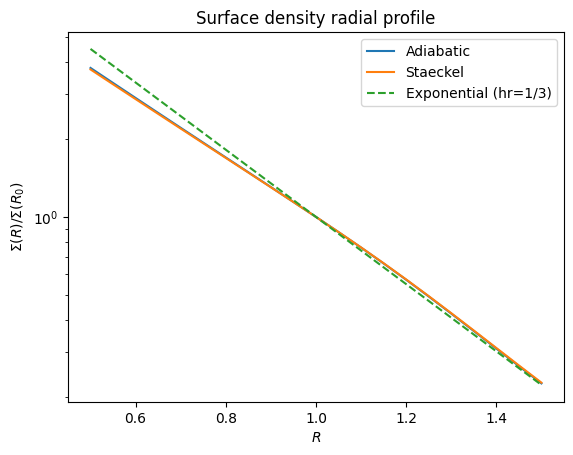
Compare the surface density from the adiabatic and Staeckel approximations to a pure exponential:
[13]:
rs = numpy.linspace(0.5, 1.5, 21)
surfr = numpy.array([qdf.surfacemass_z(r) for r in rs])
surfrS = numpy.array([qdfS.surfacemass_z(r) for r in rs])
plt.semilogy(rs, surfr / surfr[10], label="Adiabatic")
plt.semilogy(rs, surfrS / surfrS[10], label="Staeckel")
plt.semilogy(
    rs, numpy.exp(-(rs - 1.0) / (1.0 / 3.0)), "--", label="Exponential (hr=1/3)"
)
plt.xlabel(r"$R$")
plt.ylabel(r"$\Sigma(R) / \Sigma(R_0)$")
plt.legend()
plt.title("Surface density radial profile");
Marginalized velocity probabilities
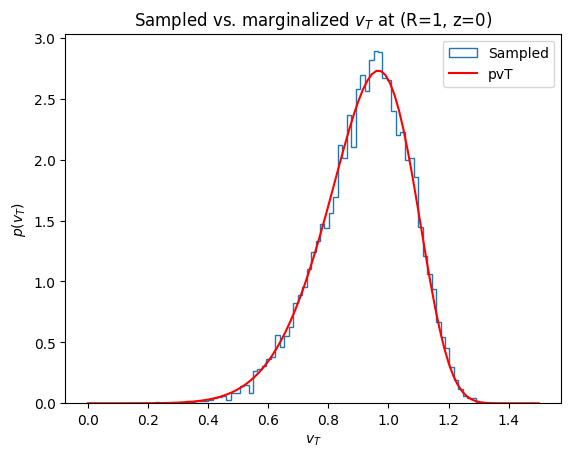
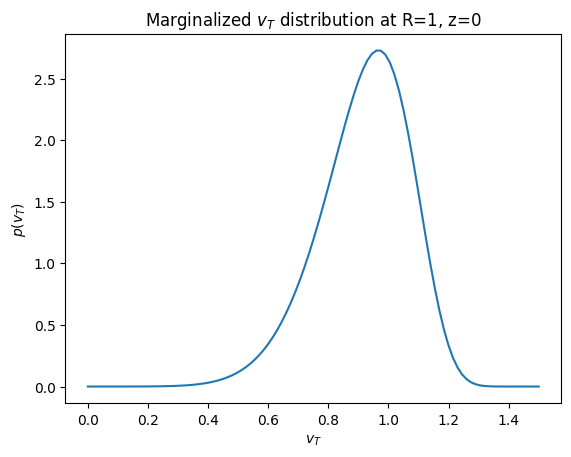
The DF provides marginalized velocity probabilities pvT, pvR, pvz, pvRvT, pvRvz, and pvTvz. These are multiplied by the density (so marginalizing over remaining velocity components gives the density).
[14]:
# Marginalized vT distribution at R=1, z=0
vts = numpy.linspace(0.0, 1.5, 101)
pvt = numpy.array([qdfS.pvT(vt, 1.0, 0.0) for vt in vts])
plt.plot(vts, pvt / numpy.sum(pvt) / (vts[1] - vts[0]))
plt.xlabel(r"$v_T$")
plt.ylabel(r"$p(v_T)$")
plt.title("Marginalized $v_T$ distribution at R=1, z=0");
Sampling velocities
We can sample velocities at a given location using sampleV:
[15]:
numpy.random.seed(1)
vs = qdfS.sampleV(1.0, 0.0, n=10000)
# Compare sampled vT distribution to the marginalized pvT
plt.hist(
    vs[:, 1], density=True, histtype="step", bins=101, range=[0.0, 1.5], label="Sampled"
)
plt.plot(vts, pvt / numpy.sum(pvt) / (vts[1] - vts[0]), "r-", label="pvT")
plt.xlabel(r"$v_T$")
plt.ylabel(r"$p(v_T)$")
plt.legend()
plt.title("Sampled vs. marginalized $v_T$ at (R=1, z=0)");
Optimization terminated successfully.
         Current function value: -6.244277
         Iterations: 1
         Function evaluations: 13