This page was generated from a Jupyter notebook. You can download it here.
Orbit Examples
This notebook gives some detailed orbit examples, including the eccentricity distribution of thick-disk stars, integrating the LMC orbit with dynamical friction, and taking the barycentric acceleration due to the LMC into account for Milky-Way orbits.
[1]:
%matplotlib inline
import warnings

warnings.filterwarnings("ignore", category=RuntimeWarning)
warnings.filterwarnings("ignore", category=UserWarning)

import numpy
import copy
from astropy import units
from matplotlib import pyplot as plt
from galpy.orbit import Orbit
from galpy.potential import MWPotential2014, ChandrasekharDynamicalFrictionForce
from galpy.util import conversion
The eccentricity distribution of the Milky Way’s thick disk
A straightforward application of galpy’s orbit-integration capabilities is to derive the eccentricity distribution for a set of thick-disk stars. We use the SDSS/SEGUE thick-disk sample compiled by Dierickx et al. (2010), which we download from Vizier:
[2]:
import os

from astropy.table import Table

from galpy.potential import LogarithmicHaloPotential

# Cache the Vizier query result locally so re-runs of this notebook don't
# repeat the catalog download, which is occasionally slow or unavailable.
_dierickx_cache = "dierickx_2010_thick_disk.fits"

if os.path.exists(_dierickx_cache):
    dierickx = Table.read(_dierickx_cache)
    print(
        f"Loaded {len(dierickx)} thick-disk stars from local cache: {_dierickx_cache}"
    )
else:
    from astroquery.vizier import Vizier

    v = Vizier(columns=["*"], row_limit=-1)
    result = v.get_catalogs("J/ApJ/725/L186")
    dierickx = result["J/ApJ/725/L186/table2"]
    print(f"Downloaded {len(dierickx)} thick-disk stars")
    dierickx.write(_dierickx_cache, format="fits", overwrite=True)
Loaded 31535 thick-disk stars from local cache: dierickx_2010_thick_disk.fits
WARNING: UnitsWarning: 'log(cm.s**-2)' did not parse as fits unit: 'log' is not a recognized function If this is meant to be a custom unit, define it with 'u.def_unit'. To have it recognized inside a file reader or other code, enable it with 'u.add_enabled_units'. For details, see https://docs.astropy.org/en/latest/units/combining_and_defining.html [astropy.units.core]
WARNING: UnitsWarning: 'log(Sun)' did not parse as fits unit: 'log' is not a recognized function If this is meant to be a custom unit, define it with 'u.def_unit'. To have it recognized inside a file reader or other code, enable it with 'u.add_enabled_units'. For details, see https://docs.astropy.org/en/latest/units/combining_and_defining.html [astropy.units.core]
Set up the phase-space coordinates as (RA, Dec, distance, pmRA, pmDec, vlos) and initialize orbits in a LogarithmicHaloPotential (a spherical potential with a flat rotation curve). All stars are formally bound in this potential (which has an infinite escape velocity), but a handful have such extreme kinematics that their orbits cause numerical issues, so we filter those out:
[3]:
vxvv = numpy.column_stack(
    [
        numpy.array(dierickx["RAJ2000"], dtype=float),
        numpy.array(dierickx["DEJ2000"], dtype=float),
        numpy.array(dierickx["Dist"], dtype=float) / 1e3,  # pc -> kpc
        numpy.array(dierickx["pmRA"], dtype=float),
        numpy.array(dierickx["pmDE"], dtype=float),
        numpy.array(dierickx["HRV"], dtype=float),
    ]
)

lp = LogarithmicHaloPotential(normalize=1.0)
all_orbits = Orbit(vxvv, radec=True, ro=8.0, vo=220.0, solarmotion="hogg")

# Filter out stars with extreme energies that cause numerical issues
E = all_orbits.E(pot=lp, use_physical=False)
keep = E < 3.0
orbits = all_orbits[keep]
e_dierickx = numpy.array(dierickx["e"], dtype=float)[keep]
print(
    f"Keeping {keep.sum()} of {len(keep)} orbits (removed {(~keep).sum()} extreme outliers)"
)
Keeping 31491 of 31535 orbits (removed 44 extreme outliers)
Now we compute eccentricities in two ways: (a) by integrating each orbit for many dynamical times and finding the actual peri- and apocenter, and (b) analytically using the Staeckel approximation, which avoids orbit integration entirely:
[4]:
# Analytic eccentricities (Staeckel approximation, very fast)
e_ana = orbits.e(analytic=True, pot=lp, delta=0.01)

# Numerical eccentricities (orbit integration)
ts = numpy.linspace(0.0, 20.0, 1001)
orbits.integrate(ts, lp)
e_int = orbits.e()
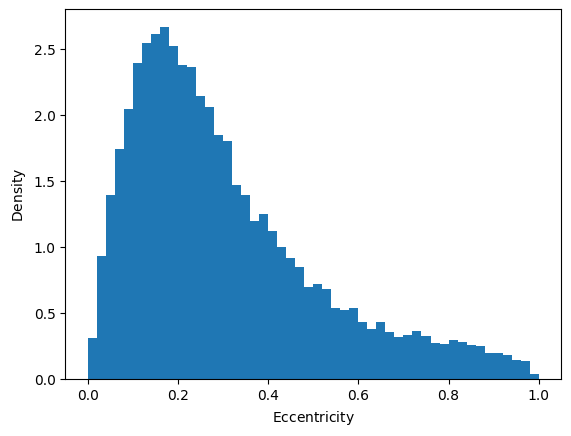
The eccentricity distribution of the thick disk peaks around \(e \approx 0.25\):
[5]:
plt.hist(e_int, bins=50, range=(0, 1), density=True)
plt.xlabel(r"$\mathrm{Eccentricity}$")
plt.ylabel(r"$\mathrm{Density}$");
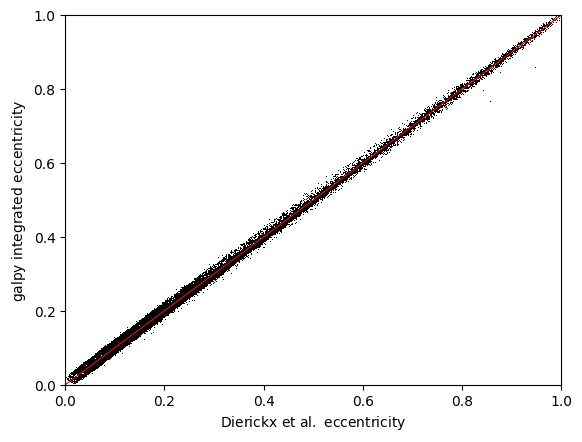
We can compare galpy’s integrated eccentricities with those published by Dierickx et al. (2010). The agreement is excellent for most stars:
[6]:
plt.plot(e_dierickx, e_int, "k,")
plt.plot([0, 1], [0, 1], "r-", lw=0.8)
plt.xlabel(r"$\mathrm{Dierickx\ et\ al.\ eccentricity}$")
plt.ylabel(r"$\mathrm{galpy\ integrated\ eccentricity}$")
plt.xlim(0, 1)
plt.ylim(0, 1);
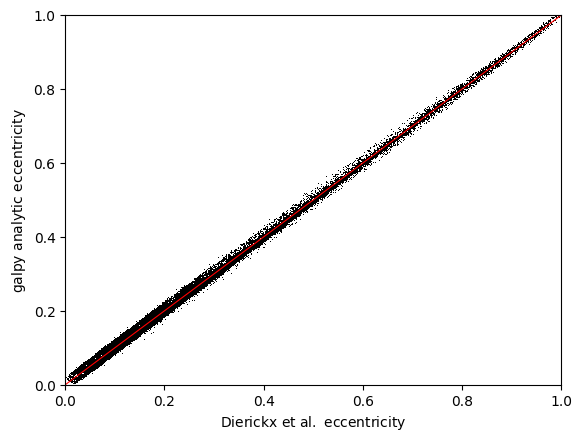
The analytic Staeckel estimates are equally good:
[7]:
plt.plot(e_dierickx, e_ana, "k,")
plt.plot([0, 1], [0, 1], "r-", lw=0.8)
plt.xlabel(r"$\mathrm{Dierickx\ et\ al.\ eccentricity}$")
plt.ylabel(r"$\mathrm{galpy\ analytic\ eccentricity}$")
plt.xlim(0, 1)
plt.ylim(0, 1);
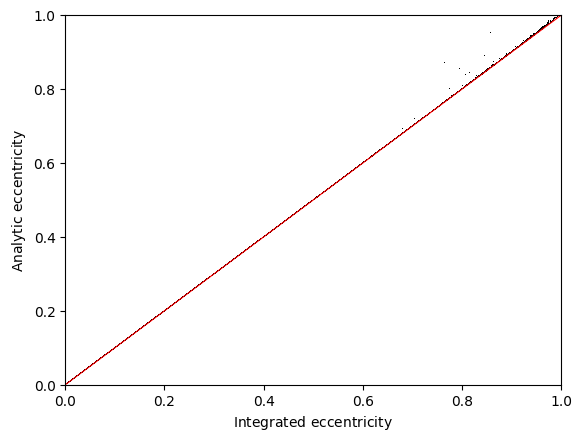
Because the LogarithmicHaloPotential is spherical, the Staeckel approximation is essentially exact. Comparing the integrated and analytic eccentricities directly confirms this:
[8]:
plt.plot(e_int, e_ana, "k,")
plt.plot([0, 1], [0, 1], "r-", lw=0.8)
plt.xlabel(r"$\mathrm{Integrated\ eccentricity}$")
plt.ylabel(r"$\mathrm{Analytic\ eccentricity}$")
plt.xlim(0, 1)
plt.ylim(0, 1);
LMC orbit with dynamical friction
The Large Magellanic Cloud (LMC) is a massive satellite of the Milky Way, so its orbit is significantly affected by dynamical friction – a frictional force of gravitational origin that occurs when a massive object travels through a sea of low-mass objects (halo stars and dark matter; see Section 19.4.1 in galaxiesbook.org). We investigate the LMC’s past and future orbit
using ChandrasekharDynamicalFrictionForce.
First, we load the current phase-space coordinates for the LMC using Orbit.from_name. Because the LMC is unbound in the default MWPotential2014, we increase the halo mass by 50% (corresponding to a Milky Way halo mass of approximately 1.2 x 10^12 Msun). We use copy.deepcopy to avoid modifying the global potential.
[9]:
o = Orbit.from_name("LMC")

# Make a deep copy to avoid modifying the global MWPotential2014
mwp = copy.deepcopy(MWPotential2014)
mwp[2] *= 1.5  # increase halo mass by 50%
Orbit without dynamical friction
First, integrate the LMC orbit backward for 10 Gyr without dynamical friction:
[10]:
ts = numpy.linspace(0.0, -10.0, 1001) * units.Gyr
o.integrate(ts, mwp)
o.plot(d1="t", d2="r");
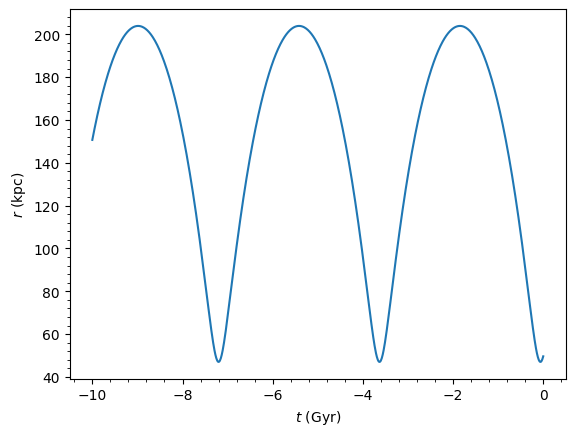
The LMC is bound with an apocenter just over 200 kpc.
Adding dynamical friction (M = 5 x 10^10 Msun)
Now add dynamical friction assuming an LMC mass of 5 x 10^10 Msun:
[11]:
cdf = ChandrasekharDynamicalFrictionForce(
    GMs=5e10 * units.Msun, rhm=5.0 * units.kpc, dens=mwp
)

# Make a copy of the orbit for the dynamical friction integration
odf = o()
odf.integrate(ts, mwp + cdf)
galpyWarning: Cannot use symplectic integration because some of the included forces are dissipative (using non-symplectic integrator dopr54_c instead)
[12]:
o.plot(d1="t", d2="r", label=r"$\mathrm{No\ DF}$")
odf.plot(
    d1="t", d2="r", overplot=True, label=r"$\mathrm{DF},\ M=5\times10^{10}\,M_\odot$"
)
plt.ylim(0.0, 660.0)
plt.legend(fontsize=17.0);
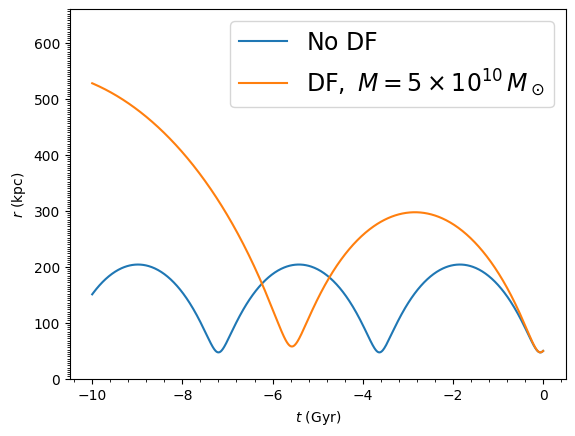
Dynamical friction removes energy from the LMC’s orbit, so the past apocenter is now around 500 kpc rather than 200 kpc, and the orbital period is much longer.
A more massive LMC (M = 10^11 Msun)
Recent observations suggest the LMC may be even more massive (> 10^11 Msun). We can change the mass in the existing ChandrasekharDynamicalFrictionForce object without re-solving the Jeans equation (necessary to initialize the dynamical-friction object):
[13]:
cdf.GMs = 1e11 * units.Msun

odf2 = o()
odf2.integrate(ts, mwp + cdf)
[14]:
o.plot(d1="t", d2="r", label=r"$\mathrm{No\ DF}$", yrange=[0.0, 660.0])
odf.plot(
    d1="t", d2="r", overplot=True, label=r"$\mathrm{DF},\ M=5\times10^{10}\,M_\odot$"
)
odf2.plot(
    d1="t", d2="r", overplot=True, label=r"$\mathrm{DF},\ M=1\times10^{11}\,M_\odot$"
)
plt.legend(fontsize=17.0);
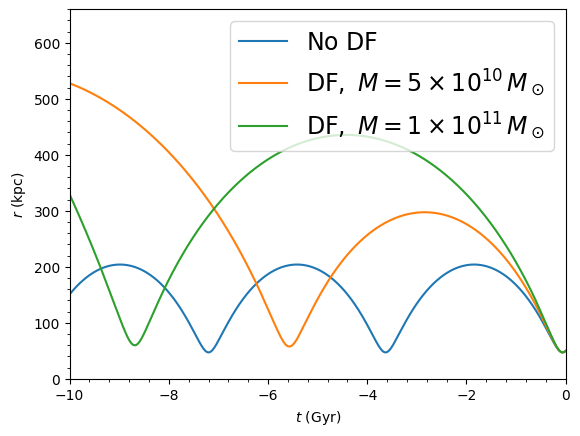
With a mass of 10^11 Msun, the LMC barely completes a full orbit over 10 Gyr!
Future orbit: merging timescale
Let’s see what happens in the future with the massive LMC. We flip the sign of the integration times (limiting to 9 Gyr to avoid numerical issues at very small radii):
[15]:
odf2.integrate(numpy.linspace(0.0, 9.0, 1001) * units.Gyr, mwp + cdf)
odf2.plot(d1="t", d2="r");
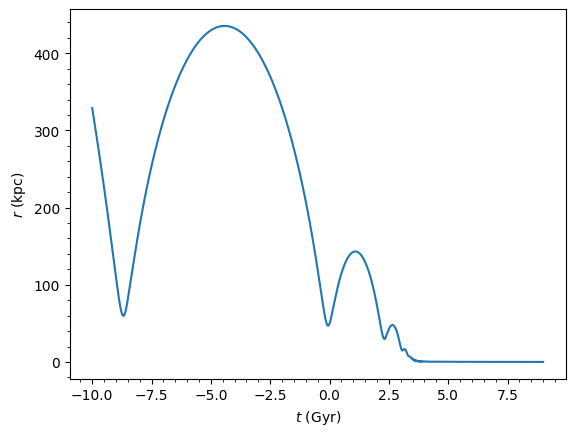
The LMC merges with the Milky Way in about 4 Gyr after a few more pericenter passages. Mass loss (not included here) would somewhat increase the merging timescale, but the merger is inevitable.
This example also illustrates thhe continuation of an existing orbit integration when integrating starting from one of the previous integrations edges. The integrate method continues the integration from the last point of the previous integration, so we can seamlessly continue the integration into the future. See Continuing integrations for more details.
Warning
When using dynamical friction, if the radius gets very small the integration can become erroneous, leading to unphysical kicks. Always inspect the full orbit to check whether a merger has happened.
Barycentric acceleration due to the LMC
The LMC is so massive that it pulls the center of the Milky Way towards it, meaning the Galactocentric reference frame is not truly inertial. We can account for this using NonInertialFrameForce.
Our approach: (1) compute the LMC orbit assuming the MW is at rest, (2) compute the acceleration at the origin due to the LMC along that orbit, (3) use NonInertialFrameForce with that acceleration.
[16]:
from galpy.potential import (
    HernquistPotential,
    MovingObjectPotential,
    NonInertialFrameForce,
    evaluateRforces,
    evaluatephitorques,
    evaluatezforces,
)
We already computed the LMC orbit with dynamical friction above. Now we re-compute it over 10 Gyr backward using the massive LMC setup:
[17]:
# Re-integrate LMC orbit backward with the heavy LMC
o_lmc = Orbit.from_name("LMC")
ts_back = numpy.linspace(0.0, -10.0, 1001) * units.Gyr
o_lmc.integrate(ts_back, mwp + cdf)
Define the LMC as a HernquistPotential and create a MovingObjectPotential that follows its orbit:
[18]:
# Hernquist potential for LMC: rhm = (1+sqrt(2)) * a, amp = 2 x mass
lmcpot = HernquistPotential(
    amp=2e11 * units.Msun, a=5.0 * units.kpc / (1.0 + numpy.sqrt(2.0))
)
moving_lmcpot = MovingObjectPotential(o_lmc, pot=lmcpot)
Compute the acceleration of the Galactic center due to the LMC by evaluating the force from moving_lmcpot at a small offset from the origin (to avoid numerical issues in cylindrical coordinates):
[19]:
loc_origin = 1e-4  # small offset in R
ax = lambda t: evaluateRforces(
    moving_lmcpot, loc_origin, 0.0, phi=0.0, t=t, use_physical=False
)
ay = lambda t: (
    evaluatephitorques(moving_lmcpot, loc_origin, 0.0, phi=0.0, t=t, use_physical=False)
    / loc_origin
)
az = lambda t: evaluatezforces(
    moving_lmcpot, loc_origin, 0.0, phi=0.0, t=t, use_physical=False
)
Set up the NonInertialFrameForce with the origin’s acceleration. We can pass the acceleration functions directly: by default (cinterp=True), NonInertialFrameForce builds a fast cubic-spline interpolation of them in C over each orbit integration’s time range, so these (relatively expensive) functions are evaluated only when setting up an integration rather than being called from C at every integration step. This makes the C orbit integration much faster and removes the need to
manually pre-interpolate the acceleration.
[20]:
nip = NonInertialFrameForce(a0=[ax, ay, az])
Effect on the Sun’s orbit
Compare the Sun’s past orbit with and without the barycentric correction. When including the non-inertial correction, we must also include the LMC’s gravitational potential (moving_lmcpot) to keep the model self-consistent:
[21]:
sunts = numpy.linspace(0.0, -3.0, 301) * units.Gyr

osun_inertial = Orbit()
osun_inertial.integrate(sunts, mwp)
osun_inertial.plotx(label=r"$\mathrm{Inertial}$")

osun_noninertial = Orbit()
osun_noninertial.integrate(sunts, mwp + nip + moving_lmcpot)
osun_noninertial.plotx(overplot=True, label=r"$\mathrm{Non-inertial}$")
plt.legend(fontsize=18.0, loc="upper left", framealpha=0.8);
galpyWarning: You specified integration times as a Quantity, but are evaluating at times not specified as a Quantity; assuming that time given is in natural (internal) units (multiply time by unit to get output at physical time)
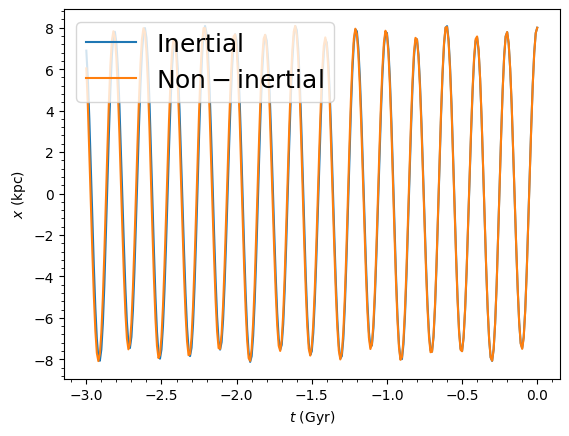
There is essentially no difference for the Sun, because its orbit is close to the Galactic center where the LMC’s pull on the origin is largely cancelled by the direct attraction to the LMC.
Effect on a distant dwarf galaxy (Fornax)
For objects orbiting far in the halo, the effect is more significant:
[22]:
fornaxts = numpy.linspace(0.0, -10.0, 101) * units.Gyr

ofornax_inertial = Orbit.from_name("Fornax")
ofornax_inertial.integrate(fornaxts, mwp)
ofornax_inertial.plotr(label=r"$\mathrm{Inertial}$")

ofornax_noninertial = Orbit.from_name("Fornax")
ofornax_noninertial.integrate(fornaxts, mwp + nip + moving_lmcpot)
ofornax_noninertial.plotr(overplot=True, label=r"$\mathrm{Non-inertial}$")
plt.autoscale()
plt.legend(fontsize=18.0, loc="lower right", framealpha=0.8);
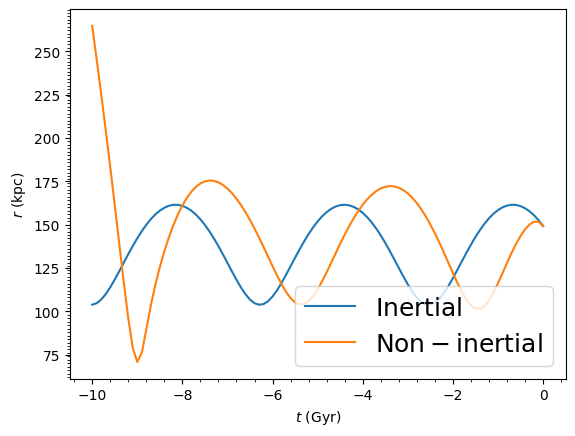
For Fornax, the past orbit differs significantly when the barycentric acceleration is taken into account. The abrupt change around -8 Gyr is caused by the LMC’s previous pericenter passage in our model.
Checking the acceleration: displacement, velocity, and force
We can verify the acceleration is realistic by integrating it to get the displacement and velocity of the MW center, and comparing to the results of Vasiliev et al. (2021):
[23]:
from scipy import integrate

vo, ro = 220.0, 8.0
int_ts_phys = numpy.linspace(-3.0, 0.0, 101)
int_ts = int_ts_phys / conversion.time_in_Gyr(vo, ro)

ax4plot = ax(int_ts)
ay4plot = ay(int_ts)
az4plot = az(int_ts)

vx4plot = integrate.cumulative_trapezoid(ax4plot, x=int_ts, initial=0.0)
vy4plot = integrate.cumulative_trapezoid(ay4plot, x=int_ts, initial=0.0)
vz4plot = integrate.cumulative_trapezoid(az4plot, x=int_ts, initial=0.0)

xx4plot = integrate.cumulative_trapezoid(vx4plot, x=int_ts, initial=0.0)
xy4plot = integrate.cumulative_trapezoid(vy4plot, x=int_ts, initial=0.0)
xz4plot = integrate.cumulative_trapezoid(vz4plot, x=int_ts, initial=0.0)

plt.figure(figsize=(11, 3.5))

plt.subplot(1, 3, 1)
plt.plot(
    int_ts_phys, xx4plot * ro, color=(0.5, 0.5, 247.0 / 256.0), lw=2.0, label=r"$x$"
)
plt.plot(
    int_ts_phys,
    xy4plot * ro,
    color=(111.0 / 256, 180.0 / 256, 109.0 / 256),
    lw=2.0,
    label=r"$y$",
)
plt.plot(
    int_ts_phys,
    xz4plot * ro,
    color=(239.0 / 256, 135.0 / 256, 132.0 / 256),
    lw=2.0,
    label=r"$z$",
)
plt.xlabel(r"$\mathrm{time}\,(\mathrm{Gyr})$")
plt.ylabel(r"$\mathrm{displacement}\,(\mathrm{kpc})$")
plt.legend(frameon=False, fontsize=18.0)

plt.subplot(1, 3, 2)
plt.plot(int_ts_phys, vx4plot * vo, color=(0.5, 0.5, 247.0 / 256.0), lw=2.0)
plt.plot(
    int_ts_phys, vy4plot * vo, color=(111.0 / 256, 180.0 / 256, 109.0 / 256), lw=2.0
)
plt.plot(
    int_ts_phys, vz4plot * vo, color=(239.0 / 256, 135.0 / 256, 132.0 / 256), lw=2.0
)
plt.xlabel(r"$\mathrm{time}\,(\mathrm{Gyr})$")
plt.ylabel(r"$\mathrm{velocity}\,(\mathrm{km\,s}^{-1})$")

plt.subplot(1, 3, 3)
plt.plot(
    int_ts_phys,
    -ax4plot * conversion.force_in_kmsMyr(vo, ro) * 1000.0,
    color=(0.5, 0.5, 247.0 / 256.0),
    lw=2.0,
)
plt.plot(
    int_ts_phys,
    -ay4plot * conversion.force_in_kmsMyr(vo, ro) * 1000.0,
    color=(111.0 / 256, 180.0 / 256, 109.0 / 256),
    lw=2.0,
)
plt.plot(
    int_ts_phys,
    -az4plot * conversion.force_in_kmsMyr(vo, ro) * 1000.0,
    color=(239.0 / 256, 135.0 / 256, 132.0 / 256),
    lw=2.0,
)
plt.xlabel(r"$\mathrm{time}\,(\mathrm{Gyr})$")
plt.ylabel(r"$\mathrm{acceleration}\,(\mathrm{km\,s}^{-1}\,\mathrm{Gyr}^{-1})$")

plt.tight_layout();
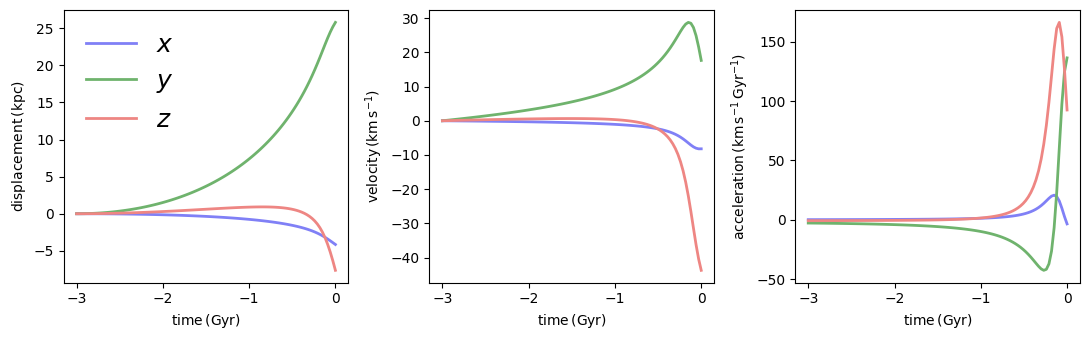
The main trends and magnitudes are consistent with Figure 10 of Vasiliev et al. (2021), confirming that our simple approximation gives a reasonable estimate of the Galactocentric reference frame’s acceleration.